The 15 Most Controversial Moments in Tennis History
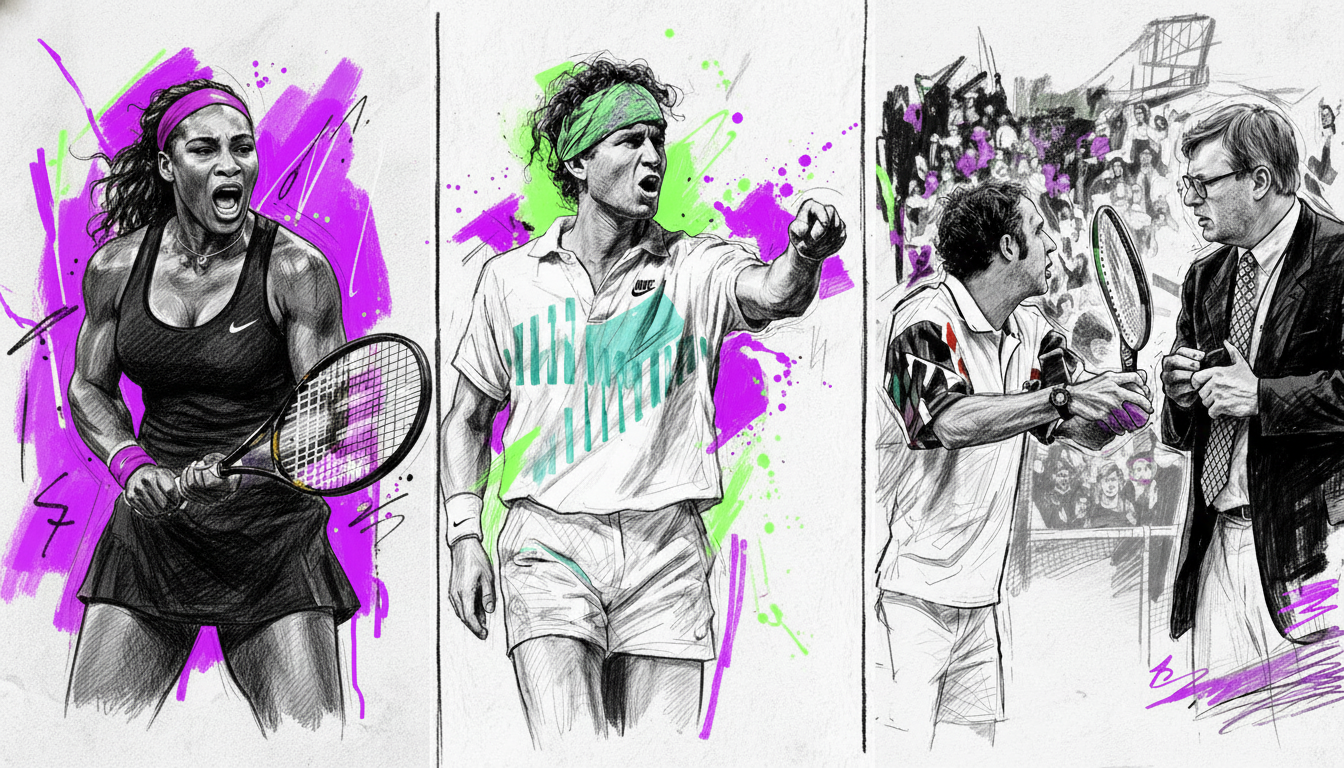
Tennis likes to present itself as a sport of restraint. White lines. Clean rituals. Controlled applause. Measured emotion.
But that has never been the full story.
Behind the etiquette sits a far more volatile tradition. Tennis has always needed a little disorder to stay alive. A meltdown that turns into folklore. A dress-code battle that exposes the sport’s contradictions. A default, a walk-off, a scandal, a scene. Moments that offend traditionalists in real time, then become part of the mythology later.
That tension is part of what makes the game so magnetic. Tennis is elegance under pressure. And pressure has a way of revealing everything.
These are the most controversial moments in tennis history. Not simply because they shocked the sport, but because they changed how the sport was seen.
What makes a tennis moment controversial?
Not every dramatic moment belongs on this list. The moments below earned their place because they did more than create headlines. They forced the tennis world to argue about authority, decorum, image, fairness, fashion, gender, class, or power.
Some happened in the middle of major finals. Others unfolded off court. A few lasted only seconds. But all of them left a mark larger than the match itself.
The 15 Most Controversial Moments in Tennis History
1. Gussie Moran turns Wimbledon fashion into front-page scandal
Long before tennis became comfortable talking about style, Gussie Moran forced the issue. At Wimbledon in 1949, her lace-trimmed undergarments became a media sensation and a source of outrage among traditionalists. It was not controversy in the modern code-violation sense. It was controversy in the older tennis sense. Image, decorum, and the fear that personality might overpower tradition.
Why it mattered: Moran proved that tennis clothing could become cultural news, not just sporting uniform. That line between performance and presentation still defines the sport.
2. The Battle of the Sexes becomes bigger than tennis
When Billie Jean King defeated Bobby Riggs in 1973, it became one of the most politically charged moments the sport had ever seen. The match was framed as spectacle, but its meaning cut much deeper. It became a referendum on gender, legitimacy, and the way women’s tennis was viewed by the wider world.
Why it mattered: It transformed tennis into a stage for a cultural argument far beyond the baseline.
3. Ilie Nastase and the spaghetti-racket uproar
Ilie Nastase built an entire career on disruption, but the 1977 spaghetti-racket episode remains one of the strangest controversies in tennis history. The equipment created bizarre spin and unpredictable bounce, igniting outrage and helping accelerate its ban.
Why it mattered: It was an early reminder that tennis does not just police behavior. It also fiercely protects the integrity of how the game is played.
4. John McEnroe turns rage into a tennis language
No figure is more synonymous with tennis chaos than John McEnroe. His umpire wars, tantrums, and running battle with the sport’s codes of conduct turned outrage into part of the show. “You cannot be serious” stopped being a complaint and became a piece of tennis folklore.
Why it mattered: McEnroe helped make rebellion marketable. He was punished, but he also made tennis impossible to ignore.
5. McEnroe’s 1990 Australian Open default shocks the sport
The outbursts were one thing. The default was something else. In Melbourne, McEnroe became the first player in decades to be defaulted from a Grand Slam for misconduct, turning his volatility into tournament history.
Why it mattered: It showed that even the sport’s biggest stars could be removed when behavior crossed a final line.
6. Andre Agassi rebels against tennis respectability
Before he became an elder statesman of the sport, Andre Agassi was a calculated provocation. The denim shorts, the neon, the anti-country-club attitude, the early resistance to Wimbledon’s aesthetic code. He understood before most that image itself could be a form of rebellion.
Why it mattered: Agassi changed tennis style by making attitude part of the package. He helped move the sport toward a more commercial, more visually self-aware future.
7. Jeff Tarango walks off Wimbledon
Few moments have captured pure tennis absurdity like Jeff Tarango defaulting himself at Wimbledon in 1995. After a series of disputes with the umpire, he simply left the court. It felt less like a match ending and more like the sport briefly losing control of its own script.
Why it mattered: It remains one of the clearest examples of a player rejecting the authority structure of the match in real time.
8. Monica Seles is stabbed in Hamburg
This was not controversy in the theatrical sense. It was something darker. In 1993, Monica Seles was stabbed on court during a match in Hamburg by a man obsessed with Steffi Graf. The attack changed careers, altered the balance of the sport, and left a permanent scar on tennis history.
Why it mattered: It remains one of the most horrifying moments the sport has ever witnessed, and one of the clearest examples of how vulnerable the stage of tennis can be.
9. Serena Williams and the 2009 US Open foot-fault explosion
In the 2009 US Open semifinal against Kim Clijsters, Serena Williams erupted after a foot-fault call late in the match. The moment became one of the defining flashpoints of her career and sparked broader debates about officiating, pressure, and how women athletes are judged when emotion spills over.
Why it mattered: It was part rules controversy, part public reckoning, and it lived far beyond the scoreboard.
10. Serena Williams, Naomi Osaka, and the 2018 US Open final
The 2018 US Open final should have been remembered simply as Naomi Osaka’s breakthrough. Instead, a code-violation dispute between Serena Williams and chair umpire Carlos Ramos turned the match into one of the most debated major finals in modern tennis.
Why it mattered: The fallout touched everything. Coaching rules. Gendered double standards. Umpire authority. Public sympathy. The treatment of one champion. The overshadowing of another.
11. Serena’s black catsuit triggers a dress-code firestorm
At Roland-Garros in 2018, Serena Williams returned wearing a black catsuit designed in part to help with circulation after childbirth-related complications. The outfit became an international talking point, and the French Open’s later response fueled a debate about control, fashion, and who gets to define what “respecting the game” looks like.
Why it mattered: It turned tennis clothing into a serious conversation about gender, power, and performance.
12. Novak Djokovic is defaulted at the 2020 US Open
When Novak Djokovic struck a ball in frustration and accidentally hit a line umpire, the result was immediate and historic. The world No. 1 was defaulted from the tournament. It was shocking partly because of who he was and partly because the rule left so little room for emotion once the act had occurred.
Why it mattered: It showed how quickly dominance can be interrupted in a sport governed by fine margins and unforgiving rules.
13. The Djokovic Australia saga engulfs the sport
The 2022 Australian Open was consumed by the visa and deportation saga surrounding Novak Djokovic. What began as a player-specific controversy quickly expanded into a global story involving public health, political authority, national image, and the responsibilities of elite athletes.
Why it mattered: Very few tennis stories have ever escaped the sport so completely and entered the center of world news.
14. Nick Kyrgios becomes the modern controversy machine
Nick Kyrgios did not create the rebellious tennis archetype, but he updated it for the social-media age. Tanking accusations, umpire feuds, fines, crowd exchanges, mid-match theater, and a public refusal to behave like a polished corporate athlete made him the sport’s most modern disruptor.
Why it mattered: Kyrgios turned controversy into a continuous state, proving the anti-hero model still thrives in a hyper-visible era.
15. Tennis keeps fighting over what it wants to be
The final controversy is bigger than a single player. Tennis has never fully settled its own identity crisis. Is it tradition or entertainment. Discipline or expression. Luxury code or cultural battleground. Every scandal, outfit, outburst, and default reopens the same argument.
Why it mattered: The sport’s most controversial moments endure because they expose a truth tennis still struggles to admit. Order has always needed chaos.
Why controversy never leaves tennis
The sport is uniquely built for friction. Tennis isolates the individual. There is no helmet, no bench to disappear into, no clock to hide behind. Emotion is visible. Silence is part of the theater. The audience can hear the muttering, the protest, the crack in composure.
That is why tennis scandals never feel small. Every breach lands against a backdrop of ritual. A player is not just arguing a call. He is violating ceremony. A woman is not just wearing a different silhouette. She is testing an institution’s comfort with power and individuality. A default is not just a rule being applied. It is order reasserting itself in public.
That contrast is exactly why these moments travel so far. They do not merely interrupt tennis. They reveal it.
The Bad Boy Tennis view
At Bad Boy Tennis, we understand that style and rebellion have always moved together. The sport’s most unforgettable figures were not always the most obedient. They were often the ones who pushed the visual language, challenged the mood of the room, or refused to perform respectability on demand.
That does not mean every controversy deserves applause. Far from it. But it does mean tennis history cannot be told honestly without the rule-breakers, the agitators, and the personalities who forced the game to show its edge.
Great sports sell excellence. Great sports culture also needs tension.
Tennis has always had both.
Final word
The most controversial moments in tennis history are not footnotes. They are part of the architecture of the sport. They changed how matches were remembered, how rules were interpreted, how players were marketed, and how audiences emotionally attached themselves to the game.
Tennis may still dress in tradition. But its history is filled with disruption.
And that is part of why we keep watching.
FAQ: Most Controversial Moments in Tennis History
-
There is no single unanimous answer, but the most commonly cited include John McEnroe’s most infamous outbursts, Serena Williams’s 2018 US Open final dispute, Novak Djokovic’s 2020 US Open default, and the 2022 Australian Open Djokovic saga.
-
John McEnroe is often the first name mentioned because his outbursts became part of the sport’s cultural vocabulary. Ilie Nastase, Jimmy Connors, Jeff Tarango, and Nick Kyrgios also belong in that conversation.
-
Because they were never just about a single moment. They often opened wider debates around officiating, dress codes, gender, race, motherhood, authority, and the standards applied to elite women athletes.
-
Yes. Novak Djokovic was defaulted from the 2020 US Open after hitting a ball in frustration that struck a line umpire.
-
Because they reveal the pressure points of the sport. They show where tradition collides with personality, and where rules collide with spectacle.